
The Short Answer: A hybrid courtroom allows some participants to appear in person while others join by video or audio link. The same standards of etiquette and professional conduct apply to everyone, with added expectations for remote participants around video presence, audio quality, and device readiness. Digital AV recording is what keeps the official record clear and complete across both formats.
Hybrid courtrooms have moved from an experimental idea to a working part of the modern court system. Judges, attorneys, witnesses, and the public now have more ways than ever to take part in a proceeding, and courts are adapting their rooms, rules, and recording systems to match.
For court administrators, the operational details are still being worked out. Hybrid hearings call for clear rules of etiquette, careful coordination between in-person and remote participants, and AV systems that hold up across both formats. The choices courts make now will shape the integrity of the official record for years to come.
What Is a Hybrid Courtroom?
A hybrid courtroom is a setup that allows some participants to attend a proceeding in person while others appear by video or audio link. The model is now common for arraignments, status conferences, motion hearings, criminal matters, and other non-trial proceedings. Witness testimony at trial generally still requires an in-person appearance in many jurisdictions, but rules vary by court system.
A single hybrid hearing might include any combination of the following:
- A judge presiding from the bench in a full-size courtroom
- Attorneys appearing in person or by video
- A defendant appearing remotely from home, office, or a detention center
- Witnesses appearing in person, with one or two expert witnesses joining by video
- A court reporter capturing the record in the hearing room
- Interpreters working in person or remotely
- Members of the public observing through a public access stream
The configuration depends on the court, the type of proceeding, and the rules set by the presiding judge.
Why Courts Are Adopting Hybrid Models
The hybrid courtroom solves several long-standing pain points in court operations. Scheduling becomes easier when out-of-state attorneys and expert witnesses do not need to travel for short appearances, reducing delays across the docket. A smaller room can be used for non-trial proceedings, freeing the full-size courtroom for jury trials. Public access improves when the courthouse provides a stream that anyone with internet access or a phone number can join.
The result is greater efficiency for the courthouse, greater flexibility for the people who use it, and a system better positioned to uphold due process across every proceeding.
Remote Appearances: When and How They Happen
Not every proceeding is eligible for remote participation. Most courts grant a remote hearing on a case-by-case basis, and many have written protocols that spell out the rules.
Under the level of detail courts for remote appearances:
- Remote attendance is granted in limited circumstances only
- Witnesses must testify in open court unless good cause is shown under Federal Rule of Civil Procedure 43(a)
- Remote observers may watch but cannot offer evidence, question witnesses, or make substantive arguments
- Participants must register at least 48 hours in advance
- Participants must connect at least 15 minutes before the hearing with video on
These rules are not unique to one court. Similar requirements appear in protocols across federal, state, and local courts. Court administrators preparing a hearing room for hybrid operation should review the rules of every jurisdiction they support, since the framework is still evolving.
Etiquette and Professional Conduct for Hybrid Hearings
A hybrid hearing is still an official court hearing. The dignity of the court applies whether a participant is sitting at counsel table or appearing from a home office.
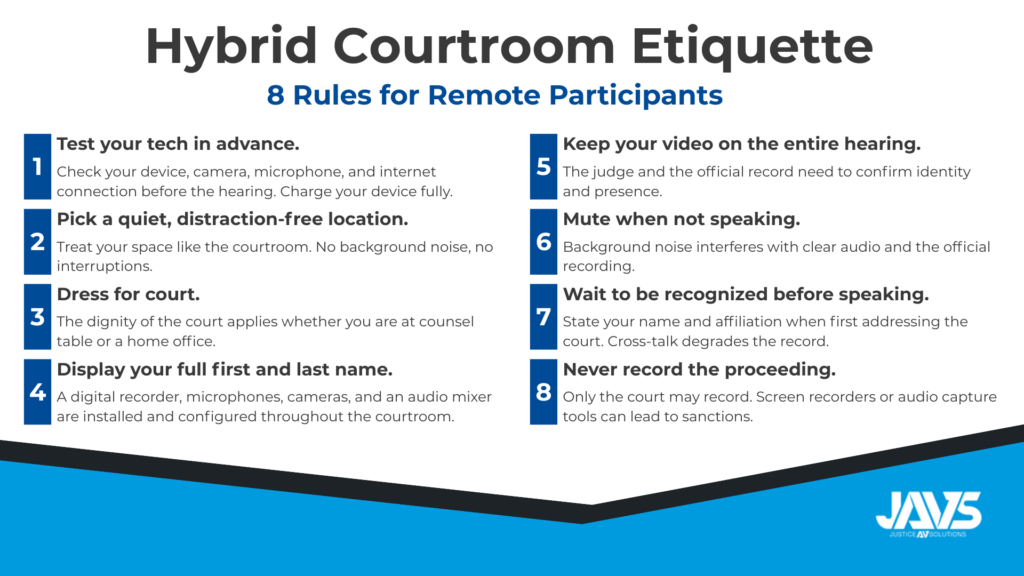
Before the Hearing
Remote participants are typically expected to:
- Test their device, camera, and microphone in advance
- Confirm clear audio and a stable internet connection
- Charge the device fully before the hearing
- Choose a quiet location with no interruptions
- Display their first and last name on the meeting platform
- Dress as they would for an in-person hearing
For in-person participants, preparation looks more familiar, although court staff should confirm that the hearing room AV systems are tested and ready before the docket begins.
During the Hearing
The following etiquette rules apply broadly across hybrid courts:
| Expectation | Why It Matters |
| Keep video on for the entire hearing | The judge and the record need to confirm identity and presence |
| Mute the microphone when not speaking | Background noise interferes with clear audio and the official recording |
| State your name and affiliation when first speaking | Helps the court reporter and the recording system attribute statements correctly |
| Wait to be recognized by the judge | Cross-talk degrades the record and disrupts the courtroom process |
| Do not record the proceeding | The court recording is the only authorized record |
That last point matters more than people realize. In nearly every jurisdiction, only the court may record a virtual hearing or in-person proceeding. Remote participants who use a screen recorder or audio capture tool can face sanctions, including the loss of their remote appearance privileges.
Special Notes for Witnesses
When a witness is permitted to appear remotely, preparation requires more care. Counsel should walk the witness through:
- Platform tools and how to use them
- How to handle exhibits that may be shared on screen
- What to do if the connection drops mid-testimony
- How to request a break or signal a problem to the court
A short technical rehearsal before the hearing can make a real difference in how the testimony lands on the record.
The Limits of Traditional Court Recording
Many courthouses still rely on legacy recording systems built around a single audio track and a stenographic record. These setups worked well when everyone in the courtroom was in the same room and spoke one at a time. They are less suited to the realities of a hybrid hearing.
Some of the limits of traditional setups include:
- A single audio channel that mixes every speaker into one track, which makes it hard to isolate voices later
- No integration with remote meeting platforms, so remote audio may be captured separately or not at all
- No built-in video record of the proceeding
- Limited annotation tools for the court reporter or clerk
- Difficulty producing accurate transcripts when multiple speakers overlap
For a hybrid court, these gaps add up quickly. If a remote witness and an in-person attorney speak at the same time, a single-channel recording may capture both voices as a muddled blend. Transcription becomes harder, accuracy suffers, and the record may not hold up on appeal.
How Digital AV Differs From Traditional Recording
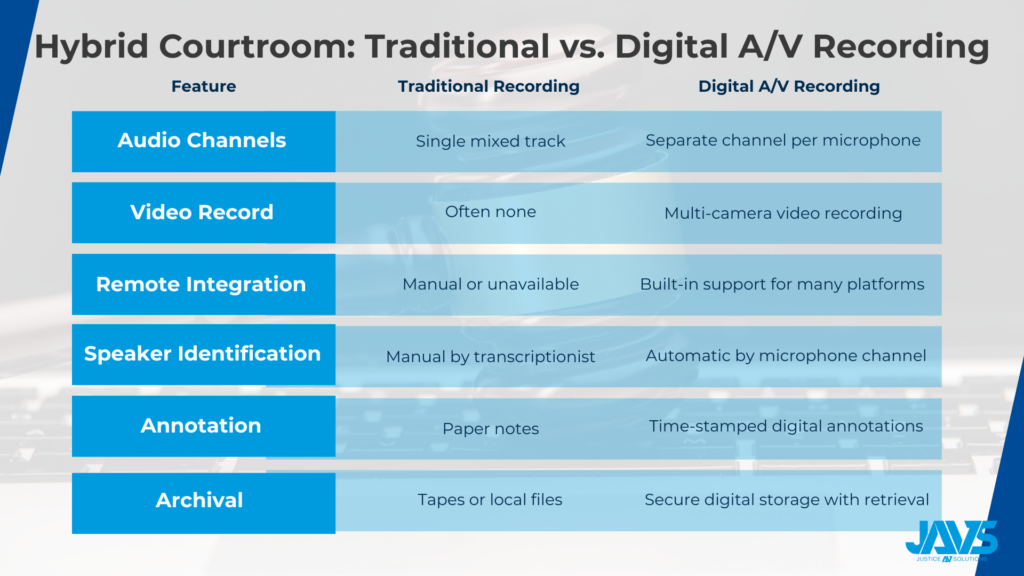
Modern digital AV systems were built with the hybrid courtroom in mind. They capture multi-channel audio, video from multiple angles, and metadata about who was speaking and when. The result is a record that supports both the live hearing and any later transcription, review, or appeal.
Digital AV also lays the foundation for AI-assisted transcription. Because each speaker has a dedicated channel, speech recognition software can attribute statements more accurately and produce a usable rough draft for a human transcriptionist to review.
How JAVS Supports the Hybrid Courtroom
Justice AV Solutions has spent more than 40 years building recording systems for courts. Today JAVS technology is installed in more than 10,000 courtrooms across seventeen countries, supporting federal, state, criminal court, and local proceedings.
For hybrid courts, the JAVS approach covers the full set of hardware and software needed to capture, manage, and publish the record, with every component designed to work together as a single connected system.
JAVS Suite 9
JAVS Suite 9 is an all-in-one, web-based platform that handles recording, logging, AI transcription, and real-time translation in a single interface. It works hand in hand with JAVS hardware to capture multi-channel audio and video of every proceeding. AI-generated text is not the same as a certified court transcript, so human review is still required before a document carries the legal weight of an official record.
Voice Lift Technology
Hybrid proceedings only work when every participant can be heard clearly, in the room and on the remote feed. JAVS combines FlexMic microphones, the AXIO digital mixer, and the SmartAmp for multi-zone amplification tuned to each courtroom’s acoustics. The result is clear, natural-sounding speech at every seat in the room, and a cleaner audio feed for remote participants on Zoom, Microsoft Teams, Google Meet, BlueJeans, or Cisco.
Hybrid Courtroom Capabilities
JAVS hybrid courtroom solutions integrate video conferencing directly into the courtroom AV system. Remote participants see and hear proceedings through HD cameras and purpose-built microphones, all managed through the same web-based software the court already uses. The platform is well suited for arraignments, status conferences, and other proceedings where participants need to appear from a detention center, office, or home. Courts can also connect a language interpreter from anywhere, which helps smaller jurisdictions find interpreters for less common languages.
Case Management Integration
JAVS recording solutions connect with existing case management software to keep every court record and case file organized. Encrypted, searchable storage means authorized users can locate recordings and documentation by case number quickly and securely.
Preparing Your Courtroom for the Future

Hybrid hearings are here to stay. Court administrators evaluating their current setup should think about how well the existing AV infrastructure handles:
- Multi-party hybrid proceedings with mixed in-person and remote participants
- Integration with the remote meeting platforms used in their jurisdiction
- Audio quality during cross-examination, sidebars, and bench conferences
- Public access streaming for open court requirements
- Long-term storage and retrieval of the official record
- Accessibility features such as real-time captioning for participants with hearing impairments
A modern digital court starts with the right AV foundation. JAVS works with justice partners across the country to design hybrid A/V systems that fit the size, budget, and procedural rules of each court. Contact us for a free consultation for court administrators who want to talk through their needs and see what a digital court setup can look like.