The Short Answer: Traditional court transcription depends on certified court reporters, and that dependency creates gaps. Scheduling delays, incomplete records, and limited accessibility are common challenges. Digital A/V recording gives courts a more complete and accessible way to capture the official record.
Court transcripts have served as the backbone of the legal record for generations. But as court systems grow more complex and demand for accurate documentation increases, the limits of traditional transcription methods are becoming harder to ignore.
No matter what court you are in, understanding these limits, and what modern digital recording can do about them, is worth your time.
What a Court Transcript Actually Is
Before getting into the gaps, it helps to clarify what a court transcript is and what it is not. An official transcript is a written record of a court proceeding, certified by an official court reporter. The court reporter’s name is attached to the document as a verification that the content has been reviewed and confirmed accurate. This distinction matters: a rough text document, or an AI-generated transcript without human review, does not meet the standard of a certified court transcript in most jurisdictions.
The Process
When a court reporter is assigned to a proceeding, they capture the record in real time using stenography or similar methods. Those notes become the source material, but they are not yet a certified transcript.
The certified written transcript is only produced when a party submits a transcript request or transcript order form. The clerk’s office coordinates with the official court reporter, who converts their notes into the polished, certified document, often within a set number of business days after payment arrangements are made. There may be a cost estimate involved, and appeal transcripts and non-appeal transcripts may follow different timelines and transcript rates.
That process works, but it has limits.
The Limits of Traditional Court Transcription
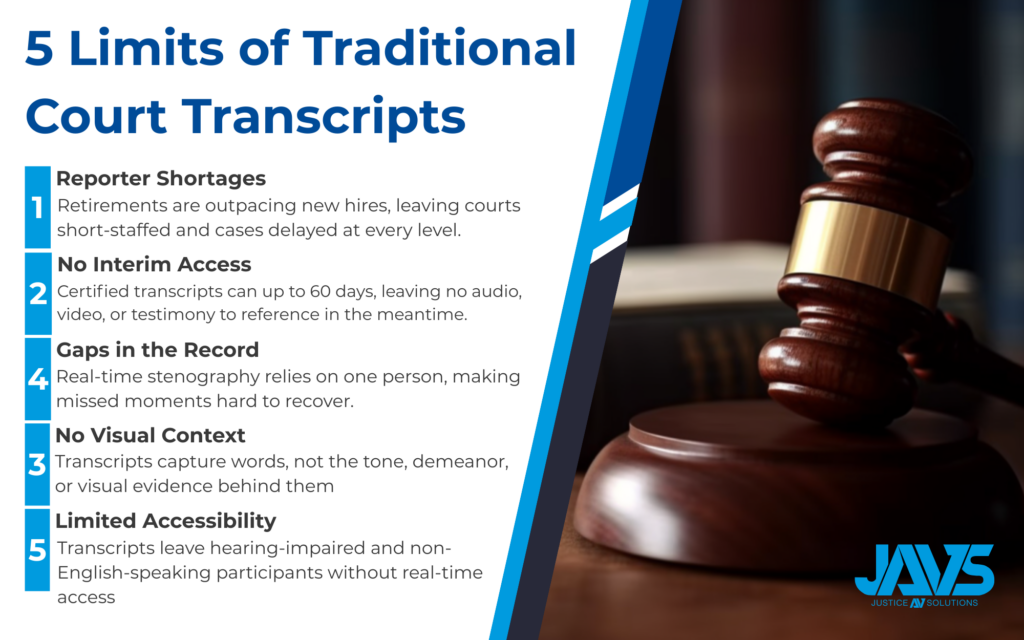
1. Court Reporter Availability
The United States is facing a real shortage of certified court reporters. Retirement rates are outpacing the number of new reporters entering the field. The result is scheduling delays, backlogged cases, and court proceedings that cannot always move forward on time.
This affects every level, from family court to federal district court.
2. No Interim Access to the Record
After a proceeding wraps, parties anticipating a transcript order can be waiting days or weeks for the certified written document. In South Carolina, for example, court reporters have up to 60 days to deliver a transcript after payment arrangements are made. During that window, there is nothing to reference. No searchable audio, no video, no way for attorneys to revisit testimony while preparing for the next step in a case. For time-sensitive appeals, that delay adds real pressure.
3. Human Error and Missed Moments
Stenographic recording puts the full burden of the record on one person in real time. Even the most skilled reporter can miss a word during fast speech, crosstalk, or poor acoustics, and without a secondary record to reference, there is no way to fill those gaps later.
4. No Visual Record
A written transcript captures words. It does not capture tone, demeanor, body language, or visual evidence being presented. In a criminal case or a family court matter where credibility is at stake, that missing context can be significant.
5. Limited Accessibility
Traditional transcript records are not always accessible to participants with hearing impairments. There is no live captioning and no built-in translation capability for non-English speakers.
How Digital A/V Recording Changes the Equation
Digital audio and video recording does not replace the official transcript. It works alongside it, or in many jurisdictions, it becomes the official record of the court proceeding itself.
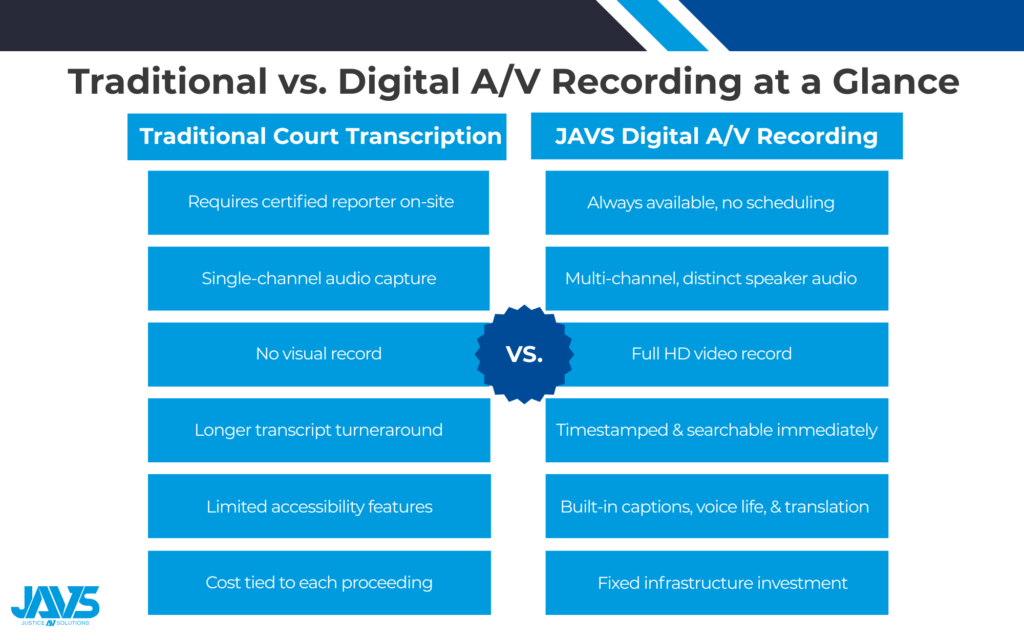
Here is how the two approaches compare:
| Feature | Traditional Court Reporter | Digital A/V Recording |
| Availability | Dependent on certified reporter | Always on |
| Visual record | No | Yes (HD video) |
| Audio channels | Single transcription | Multi-channel, speaker-separated |
| Real-time captions | No | Yes (AI-powered) |
| Accessibility tools | Limited | Voice lift, captions, remote access |
| Cost over time | Per-proceeding reporter fees | Fixed infrastructure investment |
| Searchability | Manual | Timestamped and searchable by case number |
Digital recording also captures audio across multiple dedicated microphone channels, with each speaker assigned their own channel. This matters when people talk over each other or when the courtroom has challenging acoustics. Court staff can isolate individual voices during review, which produces more accurate documentation of the record.
A/V Recording as the Official Record
Some courts already use electronic recording as their official record, eliminating the need for a court reporter to be present in every proceeding. Kentucky has operated this way for decades, having partnered with Justice AV Solutions (JAVS) since 1985. That long-running model has proven the approach can hold up legally, operationally, and financially over time.
Practical Key JAVS Solutions That Directly Address Transcript Gaps Steps
JAVS has been building courtroom-specific audio and video recording systems for over 40 years. Our systems are installed in more than 10,000 courtrooms across the United States and 17 countries. Every component, from microphones to cameras to software, is designed and manufactured specifically for court use.
JAVS Suite 9
JAVS Suite 9 is an all-in-one, web-based courtroom software platform. It handles recording, logging, AI transcription, and real-time translation in a single interface. It is important to note that AI-generated text produced during a proceeding is not the same as a certified court transcript. Human review is still required before a document carries the legal weight of an official transcript. JAVS systems are designed to support and accelerate that review process, not bypass it.
Voice Lift Technology
One of the most common accessibility issues in a courtroom is that participants in the back cannot hear clearly. JAVS addresses this with a purpose-built voice lift solution that uses FlexMic microphones with software-definable pickup patterns, the AXIO digital mixer for real-time audio processing, and the SmartAmp for multi-zone amplification tailored to each courtroom’s acoustics. The result is clear, natural-sounding speech at every seat in the room, without feedback or echo.
Hybrid Courtroom Capabilities
JAVS hybrid courtroom solutions integrate video conferencing directly into the courtroom AV system. Remote participants see and hear proceedings through HD cameras and purpose-built microphones. The web-based interface works across devices and operating systems, and courts can connect a language interpreter from anywhere, which helps smaller jurisdictions find interpreters for less common languages.
This matters for transcript accuracy too. When every participant can be clearly heard and seen, the quality of the audio and video record improves across the board.
About Justice AV Solutions (JAVS) Justice AV Solutions is a leading provider of courtroom recording and AV integration solutions for courts across the United States. With decades of experience and a comprehensive product suite, JAVS delivers reliable, scalable systems designed for the modern judiciary.
Case Management Integration
JAVS recording solutions connect with existing case management software to reduce duplicate data entry and keep every court record and case file organized. Court staff spend less time on administrative tasks and more time focused on the proceeding itself. Encrypted, searchable storage means authorized users can locate recordings, audio recordings, and documentation by case number quickly and securely.
What This Means for Transcript Requests and Court Operations
The practical impact shows up in a few ways:
- Solution for court reporter shortage: Digital recording alleviates the high demand on court reporters and helps prevent their risk of being spread thin. This allows court reporters to only be present when truly necessary.
- Faster access to the record: When a party submits a transcript request or a transcript order, having a timestamped, multi-channel digital recording gives the transcriptionist or digital recording technician a cleaner, more complete source file to work from. This can help reduce delays.
- More complete documentation: A video record captures more than words in the context of appeal transcripts and non-appeal transcripts. Attorneys and judges reviewing the record for an appellate court can see the visual context of the original proceeding.
- Accessibility built in: Real-time captions, voice lift, and remote participation tools mean more participants can follow the court proceeding as it happens. This reduces the number of accommodations that court services staff need to arrange case by case.
Cost visibility: Digital recording reduces the reliance on per-proceeding court reporter fees. Courts can establish clearer transcript rates and more predictable costs over time for budget planning.
The Bottom Line on Court Transcripts and Digital Recording
Court transcripts remain the legal standard for certified documentation of a court proceeding. That is not changing. What is changing is how courts capture the record that transcripts are built from, and how accessible that record is to everyone involved in the case.
Digital A/V recording fills the gaps that traditional transcription cannot: the visual record, the multi-channel audio, the real-time captions, and the ability to produce an accurate and accessible account of the proceeding even when no official court reporter is in the room.
JAVS has been working on this problem for over 40 years, and our solutions are designed intricately and methodically for court environments. The system is built to give courts the complete record they need, from the initial recording to hybrid participation tools, in a format that serves everyone from the clerk’s office to the appellate court.Ready to learn more? Contact JAVS for a free consultation to discuss what the right recording solution looks like for your courtroom.