
The Short Answer: The court reporter shortage means many courts can no longer staff a certified reporter for every hearing, which leaves some proceedings without a verbatim record and puts litigants’ right to appeal at risk. To keep an official record when no reporter is available, a growing number of courts are turning to electronic recording, and several states already use it when a reporter isn’t available. California joined them in August 2026, when its Supreme Court ruled that courts must allow electronic recording for qualifying low-income litigants when a certified reporter cannot be found.
Courts are running out of court reporters, and the gap widens every year. Fewer people train for the job, more reporters are near retirement, and the dockets are not getting lighter. When a hearing goes forward without anyone capturing it, the record is the first thing at risk, which is why the shortage has moved from a staffing headache to an access-to-justice problem.
The Shortage is Real, and It Keeps Accelerating
The pipeline math is stark. One widely cited industry outlook found that for every 1,120 stenographers who retire, only about 200 new ones enter the field. Some state boards have logged applicant declines as steep as 85% over five years. The workforce is also aging, with roughly half of working reporters already eligible to retire.
Stenographers, the certified shorthand reporters who capture proceedings live, take years to train and certify. Court reporter schools have been closing for years, which chokes the supply of new reporters before it starts. The National Court Reporters Association has tracked the decline, and its own membership data points the same direction. When a court loses a reporter, replacing that person is rarely a matter of weeks. In many regions it is a matter of years, if it happens at all.
What a Shortage of Court Reporters Does to a Docket
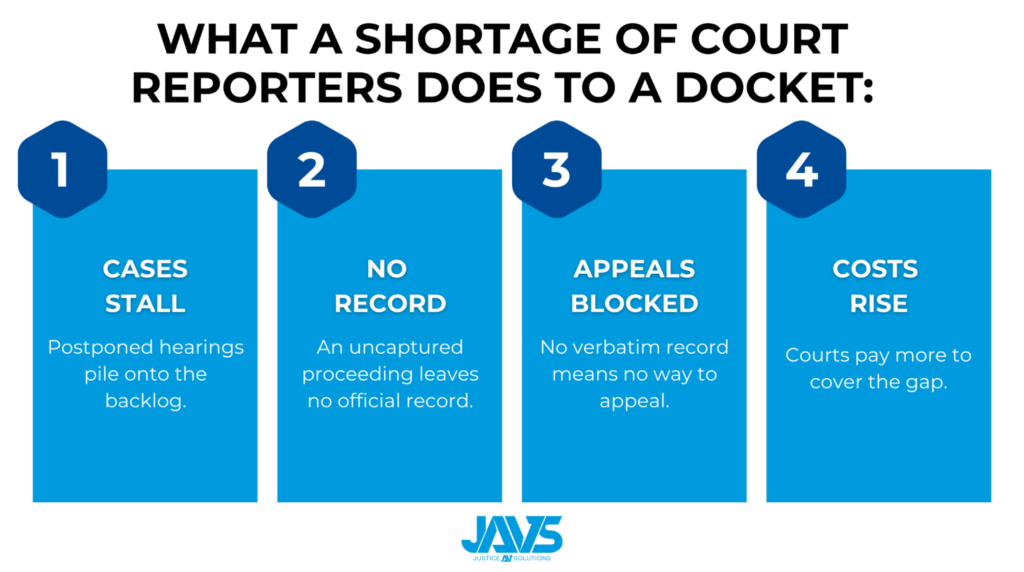
Hearings still happen when no reporter is available, and the consequences show up downstream:
- Cases get postponed when nobody can cover them, which thickens the backlog.
- A proceeding that goes forward uncaptured may leave no official record at all.
- A litigant who wants to challenge a ruling needs a verbatim record to show what happened, and without one there is often no way to appeal.
The strain reaches past the courtroom. Private court reporter availability has tightened across the deposition market too, where firms now lean on remote deposition scheduling to secure any certified reporter at all and save in-person deposition slots for testimony where being in the room matters. Either way, the reporter is the bottleneck, and the courts and the private bar compete for one shrinking group of people.
California Forces the Question
No state has felt this harder than California. Since 2023, more than 3 million California proceedings have gone forward without a written transcription. By 2025, about 70% of family law, probate, and unlimited civil hearings were happening without any verbatim record. The gap grew wide enough to be described as a constitutional crisis, because low-income litigants who could not afford a private court reporter were losing their practical ability to appeal.
What the California Supreme Court Ruled
In August 2026, the California Supreme Court answered. In a unanimous decision, Family Violence Appellate Project v. Superior Court, the court held that a superior court must allow electronic recording to create a verbatim record when an official court reporter is unavailable and a qualifying litigant cannot pay for a private court reporter.
The ruling reaches the cases where the shortage bites hardest: the civil proceedings where people are least likely to afford a private reporter. California already permitted electronic recording in some criminal proceedings, such as misdemeanors and infractions, which made the civil gap harder to defend. The decision arrived over the objection of reporter unions, which had argued for years that only a certified professional guarantees an accurate record. The Judicial Council, for its part, has pushed to let courts use electronic recording in any civil case when a reporter is not available.
What It Means for Court Operations
For California courts, the effect is immediate. A superior court that cannot staff a reporter now has a duty to capture the audio recording of qualifying hearings and produce a usable record. That turns a legal ruling into an operations problem. What equipment records the hearing? Where do the files live? How does a party later get a transcript?
A Model That Already Works in Kentucky
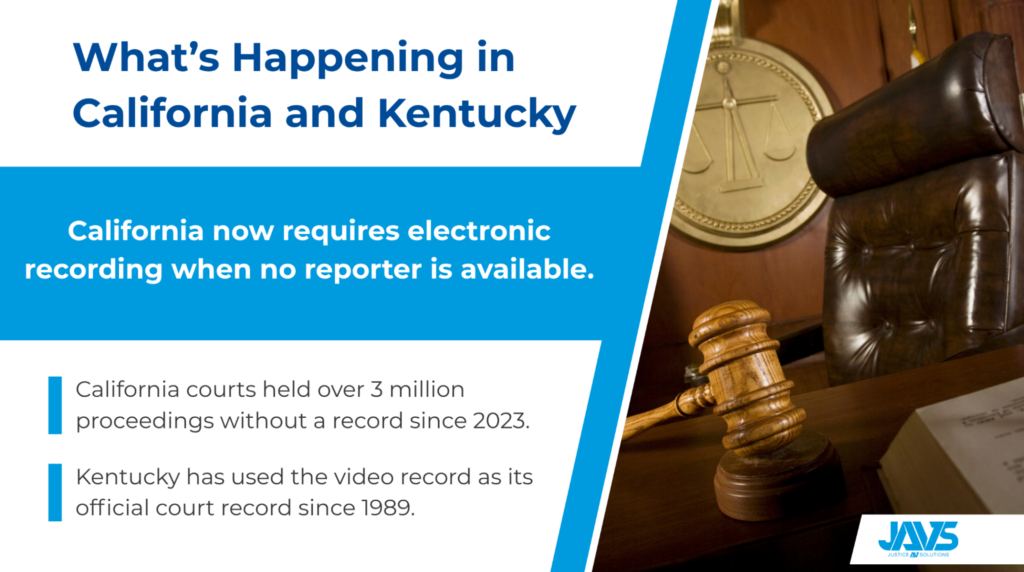
Kentucky settled this question decades ago. The Commonwealth began moving to digital courtroom recording in the 1980s and, by 1989, treated the video record as the official record on appeal. That one decision removed the need for a stenographer in every courtroom. A California Judicial Council study later cited Kentucky’s estimate that recording saved the state about $19.4 million a year.
Justice AV Solutions (JAVS) grew out of that first Kentucky courtroom, and its digital court reporting systems now run in more than 10,000 courtrooms across the United States and 17 countries. The approach that reads as new in California courts has a 40-year track record somewhere else. Electronic recording is not new to the federal system either, since federal courts and many other states have relied on it for years, which is part of why the California Supreme Court treated it as a proven alternative rather than an experiment.
Kentucky put the work back in the spotlight in August 2026, breaking ground on a new $14.1 million Court of Appeals headquarters in Frankfort to open a yearlong celebration of 50 years of unified justice. JAVS was named during the ceremony, a nod to a system that started in one trial court and spread. As Andrew Green, president and CEO of JAVS, puts it: “there is a solution for replacing those court reporters, and Kentucky has been doing it since 1989: the video record.”
| Method | Who runs it | What it produces |
| Stenographer (certified shorthand reporter) | An on-site certified reporter typing on a stenotype machine | A verbatim record and certified transcript in real time |
| Voice writers | A trained reporter speaking testimony into a masked microphone | A verbatim record transcribed from the reporter’s voiced audio |
| Digital court reporter | A staffer who monitors and annotates the electronic recording | Audio and video captured live, transcribed afterward |
| Electronic recording (no operator) | Automated microphones and cameras, started and stopped by staff | An audio and video official record, transcribed on request |
Ways Courts Capture the Record
Short-staffed courts often lean on a digital court reporter to bridge the gap, since the role costs less to train than a stenographer while recruiting continues.
What JAVS Offers a Short-Staffed Court
For a court reacting to a lost reporter or a new mandate, the practical question is what goes in the room. Justice AV Solutions builds the capture layer: purpose-built boundary microphones in zones around the courtroom, digital mixers, and cameras, all controlled by the web-based JAVS Suite platforms.
Clean capture feeds everything downstream. Any artificial intelligence tool that adds captions or a draft transcript is only as good as the audio it receives, and background noise produces a poor result no matter how good the software is.
Suite 9 runs from a web browser instead of a desktop install, which keeps day-to-day operation simple:
- A court can update one room without re-imaging every machine in the building.
- Staff open the recorder’s address in Edge or Chrome, tie it to the case management system, pick the session, and hit record.
- No dedicated operator sits in the room. Someone starts the recording in the morning and stops it at the end of the day.
On top of capture, the NextGen AI layer adds real-time captioning, speaker labeling, and searchable, time-stamped records. JAVS treats the audio and video as the official record and uses AI to make that record searchable rather than to replace human judgment. A draft transcript generated by software is not the same thing as a certified transcript that a person has reviewed.
Accessibility Comes with the Same System
The equipment that solves a staffing problem also widens equal access to court proceedings:
- Assistive listening devices feed audio to anyone hard of hearing.
- A sign language interpreter can appear in a picture-in-picture window.
- Live translation renders spoken English into several languages at once for a participant following along in the room.
- Voice Lift raises speech intelligibility for people in the gallery.
For hybrid court hearings, remote participants join over Zoom or Teams through the same platform, and the recording captures them as part of the record.
Evidence on the Record
An integrated audio and video system captures what gets shown, not only what gets said. A document camera and laptop connections for counsel let exhibits become part of the recording itself, which puts the evidence into the official record the way the room saw it. For legal professionals reviewing a case later, the argument and the exhibit sit together in one searchable file.
What This Means for Your Court
The court reporter shortage will not reverse on its own. Fewer stenographers are entering the field, more are retiring, and rulings like California’s are turning electronic recording from an option into an expectation. The courts that handle this well treat the record as infrastructure, not as a person they hope to hire.
Justice AV Solutions has spent 40 years building that infrastructure for courts, and only for courts. A recording system captures every proceeding reliably, keeps the official record under the court’s control, and holds up for about a decade of daily use. As Green puts it, “A reliable court record is there every day. It’s ready at the touch of a button.”
If a reporter vacancy or a new recording requirement is on your court’s near-term horizon, a short consultation will show what a rollout looks like in your rooms. Reach out to JAVS to see the NextGen courtroom record for yourself.