

Courts across the United States are facing a significant challenge. The demand for court reporters continues to grow while the number of certified court reporters entering the field has steadily declined. This shortage has pushed courts to explore new solutions, and artificial intelligence has emerged as a tool that could help bridge the gap.
But does this mean AI will replace court reporters entirely? The answer is more nuanced than a simple yes or no.
The Court Reporter Shortage: Why Courts Are Looking for Alternatives
The number of stenographic court reporters has been declining in recent years. Many experienced reporters are reaching retirement age, and fewer people are entering training programs to replace them.
Why the Shortage Matters
This shortage creates real problems for the legal system:
- Delayed cases: Proceedings get pushed back when courts cannot find an available reporter, creating backlogs.
- Scheduling challenges: Legal teams struggle to coordinate depositions and hearings around limited availability.
- Incomplete records: Some proceedings may lack the official record that parties need for appeals.
How Courts Are Responding
In response, many courts have turned to digital recording as a supplement to traditional court reporting. Digital recording systems capture multi-channel audio and video of proceedings, creating a complete record that can be transcribed later.
A Proven Model That Has Worked for Decades
This approach is not new. In the 1980s, Kentucky faced a challenge that mirrors what many courts are experiencing today: a growing shortage of court reporters that created scheduling bottlenecks, delayed proceedings, and an increasing backlog of cases. Rather than relying solely on stenographic reporting, Kentucky partnered with Justice AV Solutions (JAVS) to implement a dedicated audio-video capture system built specifically for courtroom use.
Today, Kentucky continues to use JAVS digital courtroom recording as the official record of the court, eliminating the need for a court reporter to be physically present in every proceeding. This long-standing success demonstrates that it is a proven, sustainable solution — not a temporary workaround — that has kept the justice system moving efficiently for decades.
How AI Transcription Works in Court Proceedings
AI transcription relies on automatic speech recognition and voice recognition technology to convert the spoken word into text. Modern AI systems use machine learning algorithms trained on vast amounts of audio data.
The AI Transcription Process
| Step | Description |
| Audio Capture | Digital recording devices capture audio from multiple microphones positioned throughout the courtroom. |
| Speech Processing | AI analyzes the digital audio and converts speech to text using speech recognition algorithms. |
| Rough Draft | The AI produces a rough draft that provides immediate access to what was said, though it may contain errors. |
| Human Review | A transcriptionist reviews and corrects the AI output to produce an accurate transcript suitable for the official record. |
Real-Time Captioning
AI transcription tools can also provide real-time transcription during proceedings. This creates captions that participants can follow along with, which is helpful for:
- Participants with hearing impairments who need visual access to spoken content
- Judges tracking complex testimony across multiple witnesses
- Attorneys referencing earlier statements during cross-examination
Will AI Replace Court Reporters?

This is the question many legal professionals are asking. The short answer is that AI is not likely to fully replace skilled court reporters anytime soon, but it is elevating how the profession operates.
What AI Does Well
- Processing large volumes of audio quickly: AI can work through hours of recordings much faster than human transcriptionists.
- Providing immediate access to text: Real-time captioning gives participants a way to follow along and reference what was said.
- Reducing costs for routine recordings: For proceedings that do not require a certified reporter, AI can lower transcription costs.
- Handling clear audio: When recording conditions are good, AI accuracy has improved significantly.
Where AI Can Fall Short
Despite advances in generative AI and speech recognition, AI transcription still faces limitations in legal settings:
- Background noise and crosstalk: Multiple people speaking at once, HVAC systems, and ambient sounds can confuse AI.
- Accents and dialects: AI may struggle with regional accents, non-native speakers, or witnesses who mumble.
- Legal vocabulary: Case names, statutes, and technical terms require specific knowledge that general AI models may lack.
- Speaker identification: Knowing who said what is critical, and AI can have difficulty attributing statements correctly.
- No real-time intervention: A human court reporter can ask for clarification. AI simply records what it hears.
The Human Element Remains Important
Federal courts and state courts often require that official records meet specific accuracy standards. A certified transcript carries legal weight because a human has verified its accuracy. AI-generated text, without human review, does not typically meet this standard.
This is why most courts treat AI as a tool that assists human professionals rather than replacing them.
The Role of Digital Recording Systems
Digital recording systems serve as the foundation for both AI transcription and traditional human transcription. Without a clear, multi-channel recording, even the best transcription software will struggle.
Why Recording Quality Matters
Multi-channel audio recording places multiple microphones throughout a courtroom, typically on the judge, each attorney table, and the witness stand. Each microphone records to a separate audio channel, which allows transcriptionists to isolate individual speakers when needed. This is particularly helpful when people speak over each other or when background noise makes certain voices difficult to hear.
Key Features of Court Recording Systems
When evaluating court recording systems, courts should consider:
- LED status indicators that show everyone in the room when recording is active
- Mute controls that allow judges to pause recording during bench conferences and sidebars
- Annotation capabilities that let court staff add timestamped notes during proceedings
- Secure storage that preserves the official record for future access and archival
- AI integration that enables real-time captioning and accelerated transcription workflows
When to Use Each Method
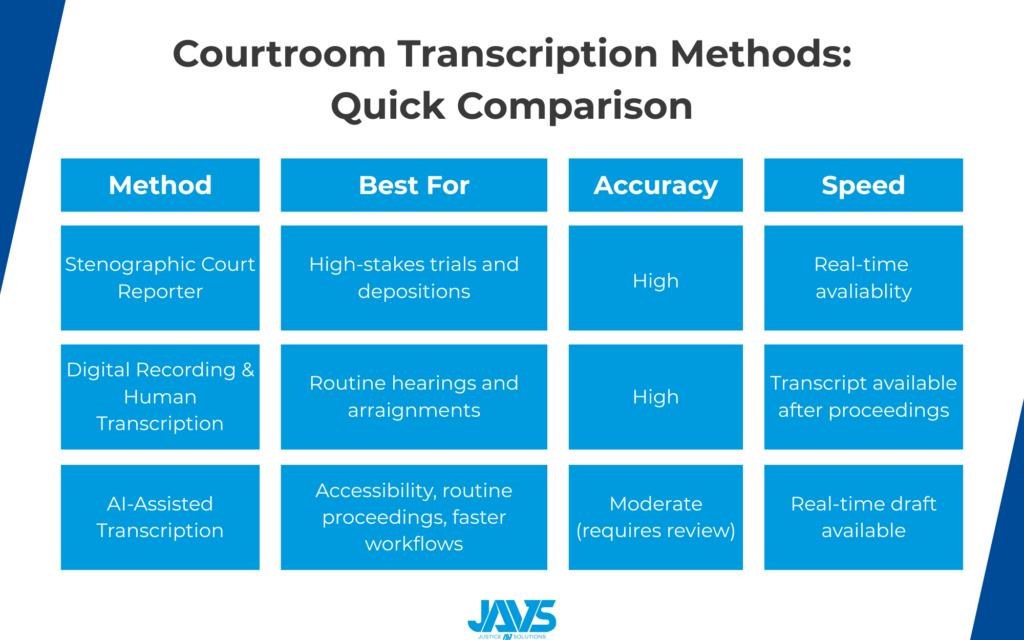
Stenographic court reporters remain the best choice for complex litigation, high-profile cases, and proceedings requiring immediate certified transcripts.
Digital recording with human transcription works well for routine hearings and courts facing reporter shortages.
AI-assisted transcription adds value for real-time accessibility, routine proceedings that don’t require a certified record, and accelerating transcription workflows.
The Future of AI in Legal Transcription
Demand for digital recording and AI-assisted tools continues to increase, driven by:
- Growth in remote depositions
- Expansion of hybrid courtroom proceedings
- Continued court reporter shortages
- Rising expectations for accessibility
The trend is toward using AI as a complement to human professionals rather than a replacement. For courts dealing with the reporter shortage, the practical solution often involves combining digital recording systems, AI tools for real-time access, and trained transcriptionists for certified transcripts.
The Bottom Line
AI is changing courtroom recording and transcription, but it is not replacing skilled court reporters. Instead, AI serves as a powerful tool that helps courts maintain accurate records during a time when traditional reporters are in short supply.
Key Takeaways
- AI assists, not replaces: Human oversight remains necessary for certified transcripts
- Recording quality matters: Quality hardware is the foundation for accurate transcription
- Multiple methods work together: Courts benefit from combining stenographers, digital recording, and AI
- Technology keeps improving: Courts investing now will be ready for future advances
Courts that invest in the right recording infrastructure today will be better positioned to take advantage of AI improvements as the technology evolves.
Making the Right Choice for Your Courtroom

Implementing new technology requires careful planning. The recording hardware needs to capture clear audio from all participants, the software needs to integrate with existing workflows, and staff need training.
Why JAVS
At Justice AV Solutions, we have been providing digital recording solutions to courtrooms for over 40 years. Our systems capture multi-channel audio from purpose-built microphones, ensuring every voice is recorded clearly on separate channels.
AI-Powered Capabilities
JAVS systems include extensive AI-powered features, like:
- Instant ASR transcription delivers fast, accurate, cost-effective results
- Real-Time Captions display spoken words as on-screen text during proceedings
- Speaker diarization identifies who said what based on microphone location
- Searchable, time-stamped records make it easy to find specific moments
- High accuracy even with accents and legal terminology
- Real-time language translation for multilingual proceedings
The Complete Solution
At JAVS, we provide end-to-end support. Our team handles:
- Installation: Professional setup tailored to your specific courtroom
- Training: Ensuring court personnel feel comfortable with the technology
- Ongoing maintenance: Support to keep systems running smoothly
With over 10,000 courtroom installations across the United States and 17 countries, we have the experience to help courts navigate this transition.
Contact us today for a free consultation to discuss your specific needs!